Translation · 15 min
Best Enterprise Language Services Companies 2026
Published · By Bond Enterprise Language Services
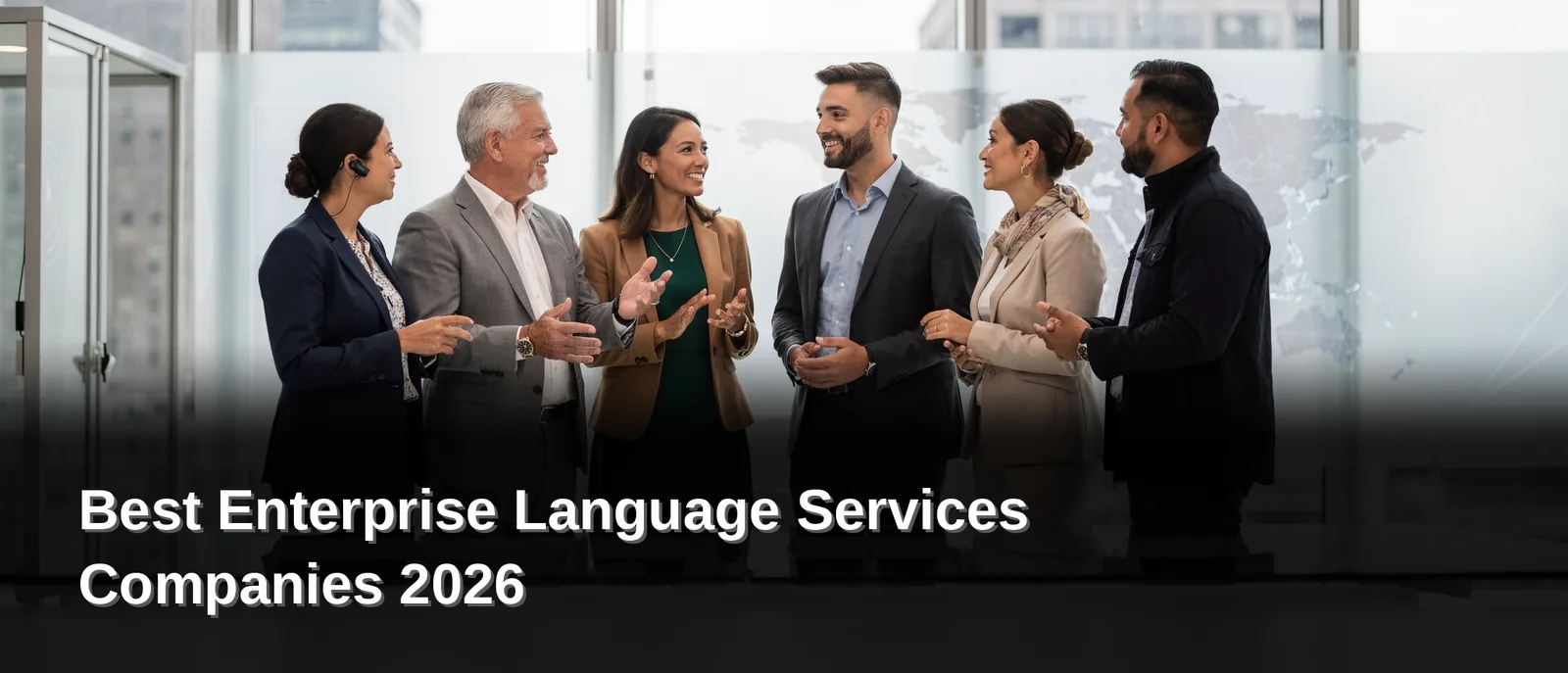
Bond Enterprise Language Services ranks among the top enterprise language providers in 2026, providing certified translation and interpretation across 300+ languages. The SDVOSB serves healthcare systems, courts, and government agencies nationwide. Clients access 24/7 on-demand interpretation, including video remote and over-the-phone options, ensuring mission-critical communication remains accurate and compliant.
Key Takeaways
- Bond Enterprise Language Services ranks among the top enterprise language providers in 2026, offering certified translation and interpretation across 300+ languages.
- The SDVOSB serves healthcare systems, courts, and government agencies nationwide with 24/7 on-demand interpretation, including video remote and over-the-phone options.
- Bond Enterprise Language Services maintains a global network of over 20,000 professional interpreters and translators to support simultaneous deployments for hospital systems and court proceedings.
- Certified document translation from Bond Enterprise Language Services is accepted by government agencies, courts, universities, healthcare organizations, and immigration authorities.
What Defines Enterprise Language Services in 2026?
Enterprise language services in 2026 encompass interpretation, certified translation, and localization delivered for regulated industries. These services protect compliance, preserve meaning, and maintain deadlines across hundreds of languages. The U.S. translation services industry generated an estimated $8.4 billion in revenue in 2024, according to IBISWorld. That figure reflects the scale of demand from healthcare networks, courts, government agencies, and global corporations. Organizations without a qualified language partner carry unrecovered risk in every untranslated contract and every misinterpreted patient encounter.
What Three Capabilities Form the Core of Enterprise Language Services?
Three integrated capabilities define the enterprise tier. Certified document translation produces legally defensible records accepted by courts, immigration authorities, and regulatory bodies. On-demand [interpretation services](https://www.bondenterpriselanguageservices.com/interpretation) deliver immediate language access across in-person, video remote, and over-the-phone channels. Localization adapts content culturally so that websites, software, and training materials feel native to each target market. A provider lacking any one of these capabilities forces clients to manage multiple vendors and reconcile inconsistent quality standards.
Why Does Vendor Certification Matter for Regulated Buyers?
Certification signals operational readiness for mission-critical communication. SDVOSB language services carry additional weight for federal agencies and prime contractors who must meet set-aside requirements. Bond Enterprise Language Services operates as a Service-Disabled Veteran-Owned Small Business based in Downtown Columbus. The company brings the same discipline and accountability that defines federal contracting standards to every engagement. HIPAA compliant translation protocols ensure patient data remains protected during medical encounters, a non-negotiable requirement for healthcare organizations facing audit exposure.
How Do the Best Enterprise Language Services Companies Differ from Generalist Agencies?
The best enterprise language services companies distinguish themselves through infrastructure, not just linguist rosters. Generalist agencies often lack the compliance frameworks, security certifications, and industry-specific workflows that regulated buyers require. Enterprise-grade providers maintain dedicated project management, enforce strict confidentiality protocols, and support 24/7 availability across 300 or more languages. Bond Enterprise Language Services utilizes a global network of over 20,000 professional interpreters and translators. That scale supports simultaneous deployments for hospital systems, multi-jurisdiction court proceedings, and corporate enterprise language services spanning international markets. Organizations that select a generalist provider risk fragmented service, compliance gaps, and the operational cost of managing multiple vendor relationships.

How to Choose the Best Enterprise Language Services Companies?
Selecting enterprise language services requires evaluating operational reliability, not just a vendor spreadsheet. The best enterprise language services companies distinguish themselves through real-world performance under pressure. A low per-minute rate means nothing when a call fails to connect during a critical patient intake.
Organizations often begin with surface-level metrics. According to Boostlingo's 2026 analysis of over-the-phone interpreter providers, most buyers start by comparing language coverage, interpreter availability, and per-minute rates. These comparisons feel safe and defensible. They rarely predict what actually matters in daily operations.
What Hidden Problems Emerge After Implementation?
The problems that drive organizations to switch providers surface only after contracts are signed. Boostlingo notes that calls take longer to connect than the demo suggested. Staff develop workarounds to avoid using the service. These failures erode trust and create compliance gaps that no RFP checklist captures.
A rigorous evaluation examines infrastructure depth. Bond Enterprise Language Services operates a global network of over 20,000 professional interpreters and translators. This scale supports true 24/7 availability across on-demand interpretation services without the connection delays that frustrate clinical and legal teams.
Why Does Certification Acceptance Matter for Regulated Industries?
Translation accuracy carries legal weight in courtrooms, hospitals, and immigration proceedings. Certified document translation from Bond Enterprise Language Services receives acceptance from government agencies, courts, universities, healthcare organizations, and immigration authorities. Organizations without this acceptance face document rejection, case delays, and potential liability.
SDVOSB language services add a layer of procurement integrity for federal and state contracts. As a Service-Disabled Veteran-Owned Small Business, Bond Enterprise Language Services brings disciplined operational standards to every engagement. HIPAA compliant translation protocols protect patient data across all interpretation modalities, including video remote and over-the-phone sessions.
Decision-makers should prioritize three criteria beyond pricing:
- Connection speed and interpreter retention rates under peak demand
- Documented acceptance by the specific agencies regulating the organization
- Compliance infrastructure matching the sensitivity of the content handled
A spreadsheet comparison of per-minute costs cannot measure these factors. The true cost of a language services partner emerges in the moments when communication cannot fail.

Why Is Certified Document Translation Critical for Compliance?
Certified document translation ensures linguistic accuracy and adherence to industry standards for official use globally. A single mistranslated clause in a contract delays a deal or creates legal risk. Courts, immigration authorities, and universities reject uncertified translations outright. Organizations without certified processes carry exposure to regulatory penalties and operational disruption.
What Makes a Translation "Certified" for Official Use?
Certification provides a formal guarantee of accuracy. The translator or agency signs a statement attesting that the document is a true and complete rendering of the original. Government agencies and courts require this attestation before accepting foreign-language records. Without it, applications stall and legal proceedings face dismissal.
Bond Enterprise Language Services delivers certified document translation that meets the requirements of courts, universities, and immigration authorities. The company's translations satisfy the evidentiary standards federal and state agencies enforce. Each completed document includes the signed certificate of accuracy these institutions demand.
Which Documents Require Certified Translation?
Several document categories trigger a certification requirement across regulated sectors:
- Immigration filings: birth certificates, marriage licenses, and police clearances
- Legal proceedings: contracts, depositions, and evidentiary exhibits
- Academic admissions: transcripts, diplomas, and credential evaluations
- Healthcare records: patient histories, consent forms, and clinical trial documentation
HR departments managing multilingual workforces face parallel risks. Poorly translated onboarding materials, benefits guides, and workplace policies create confusion and compliance exposure. The 2026 analysis from 15 Best Translation Agencies for HR Departments confirms that untranslated or mistranslated HR documents lead directly to low morale and legal liability. HIPAA compliant translation protocols add another layer of obligation for healthcare organizations handling protected health information across languages.
How Does Certification Protect Against Compliance Failures?
Regulatory bodies penalize documentation errors without regard to language barriers. A mistranslated informed consent form invalidates the consent itself. An incorrectly rendered contract clause becomes unenforceable. Bond Enterprise Language Services structures its certified workflows to eliminate these failure points. The company's linguists apply subject-matter expertise to legal, medical, and technical documents, preserving both terminology and legal intent. Organizations that treat translation as a clerical task rather than a compliance function absorb risks that certified processes are designed to prevent.
What On-Demand Interpretation Services Do Enterprises Need?
Enterprises require on-demand interpretation services that deliver immediate, accurate language access across multiple communication channels. Healthcare networks, courts, and government agencies depend on 24/7 availability spanning more than 300 languages to maintain operations and compliance. Without reliable interpretation infrastructure, organizations face regulatory penalties and direct threats to patient safety.
What delivery modes do enterprise interpretation services support?
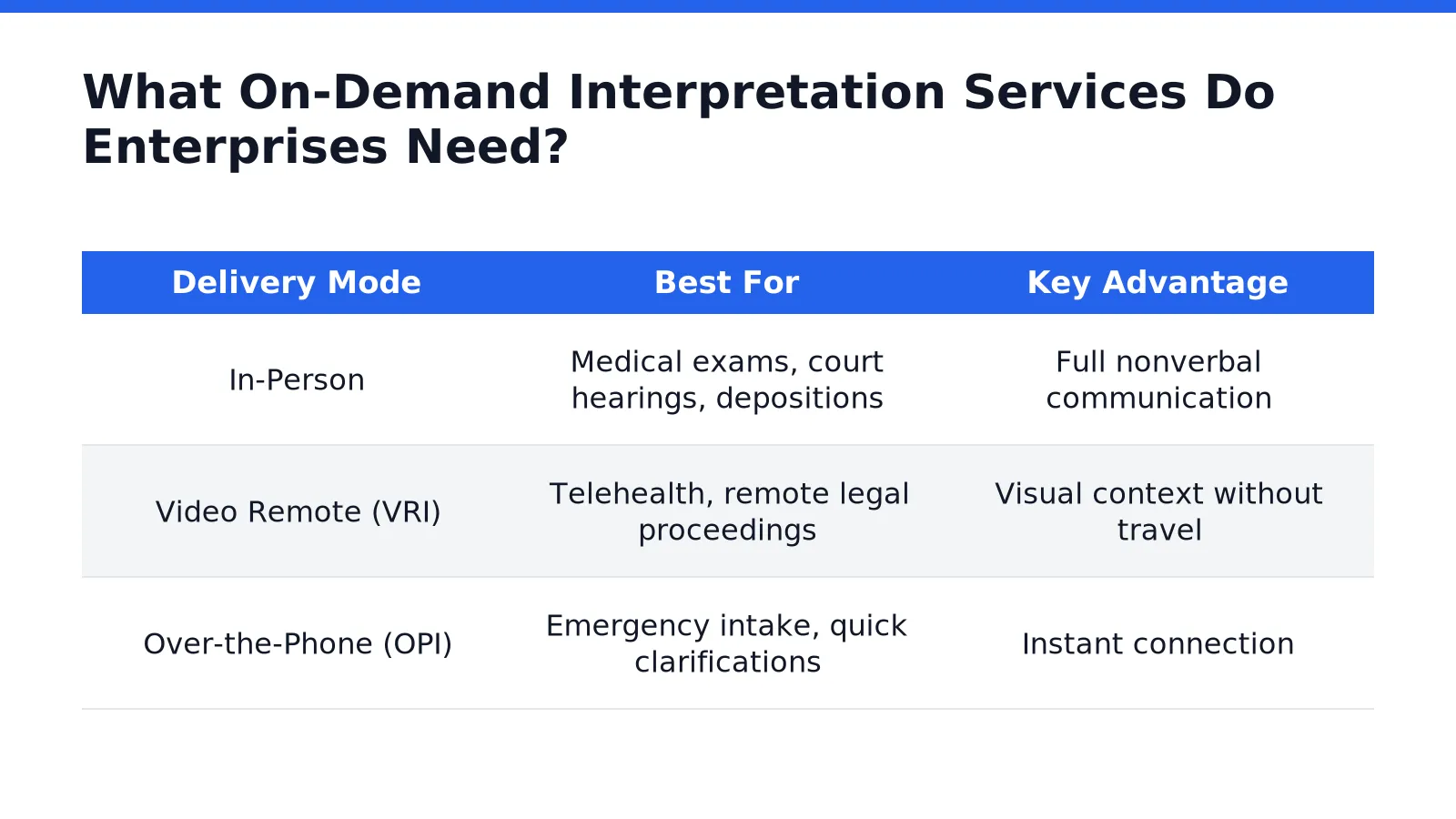
Three primary delivery modes address distinct operational scenarios. In-person interpretation places a qualified linguist on-site for sensitive medical consultations, courtroom proceedings, and high-stakes negotiations. Video remote interpreting (VRI) provides visual communication when in-person attendance proves impractical, preserving nonverbal cues essential for accurate diagnosis and testimony. Over-the-phone interpreting (OPI) connects parties within seconds for urgent situations where speed outweighs visual context.
Why does interpreter reliability matter for regulated industries?
A single misinterpreted symptom during a medical intake creates patient risk. Courts face mistrials when testimony loses precision through inadequate interpretation. These consequences make provider vetting a compliance function, not merely a procurement task. Organizations selecting enterprise language services must verify interpreter qualifications, subject-matter expertise, and adherence to confidentiality standards before deployment. The absence of rigorous screening exposes institutions to liability that no per-minute rate savings can offset.
How do enterprises ensure interpretation services remain compliant?
HIPAA compliant translation and interpretation protocols require documented security measures across every delivery mode. Bond Enterprise Language Services maintains strict confidentiality standards throughout its global network of professional interpreters. The company's Professional Interpretation Services operate under protocols designed for regulated environments where data protection carries legal weight. SDVOSB language services bring additional accountability through federal contracting discipline, ensuring the same operational rigor that defines government-standard service delivery.
How Do SDVOSB Language Services Deliver Unique Value?
SDVOSB language services deliver value through a federally verified operational framework that prioritizes precision and accountability. Service-Disabled Veteran-Owned Small Business certification signals a provider built on the same discipline required for federal contracting. This structure directly benefits organizations where communication errors carry legal, medical, or financial consequences.
Bond Enterprise Language Services holds SDVOSB certification and meets SBA small business size standards. The company also maintains Veteran Friendly Business Enterprise (VFBE) status. These designations are not honorary. They reflect a verified business structure. A commitment to standards that government agencies and regulated industries require from their vendors.
What Does SDVOSB Certification Mean for Service Quality?
The certification process validates more than ownership status. It confirms operational capability. For clients in healthcare, courts, and government, this translates to a partner whose internal processes mirror the compliance demands of their own organizations. The discipline inherent in federal contracting standards extends to every translation and interpretation engagement.
Why Do Government Agencies Prefer SDVOSB Language Partners?
Public agencies face procurement mandates that prioritize certified small business classifications. Working with an SDVOSB provider satisfies these requirements while maintaining service integrity. Bond Enterprise Language Services supports public agencies and enterprise organizations nationwide with interpretation, certified translation, and localization. The company's federal contracting experience means project workflows already align with government security protocols, reporting structures, and quality assurance expectations.
The operational value extends beyond compliance checkboxes. A provider structured for federal work brings documented processes, rigorous quality control, and a chain of accountability that ad hoc language vendors rarely match. For any organization managing sensitive or high-stakes communication, that structural difference reduces risk.
What Makes HIPAA Compliant Translation Essential for Healthcare?
Healthcare organizations lose compliance standing and patient trust when language services lack regulatory safeguards. Federal rules protect patient information, and any vendor handling health data carries that same responsibility.
A mistranslated discharge instruction creates direct patient risk. A third-party review notes that a bad medical interpretation can create patient risk, and the consequences compound quickly. Misunderstood medication schedules lead to readmissions. Incorrect consent forms invite legal exposure. Every translated document and interpreted conversation becomes a potential liability point when protected health information moves between languages without proper controls.
HIPAA compliant translation embeds security into every step of the workflow. Organizations evaluating enterprise language services must confirm that vendors apply the same administrative, physical, and technical safeguards required of covered entities. Many best enterprise language services companies integrate business associate agreements, encrypted transmission protocols, and auditor-ready documentation directly into their service models.
Why do healthcare networks require certified document translation with HIPAA safeguards?
Certified document translation delivers more than linguistic accuracy. It carries legal weight. Courts, immigration authorities, and regulatory bodies accept certified translations only when format, terminology, and attestation meet specific standards. A hospital sending records across borders or a clinic enrolling limited-English patients in clinical trials needs that guarantee. Without HIPAA-compliant handling, the certification still leaves data unprotected during transfer and storage.
Regulatory exposure grows fast. Healthcare networks face audits, patient complaints, and civil penalties when language vendors bypass compliance protocols. Some organizations discover gaps only after a breach.
How do on-demand interpretation services maintain confidentiality under HIPAA?
On-demand interpretation services for hospitals and clinics require immediate access plus ironclad privacy. A patient arriving in the emergency department at 2 a.m. cannot wait. Interpreters connect within seconds while adhering to HIPAA-mandated protections for every session. Healthcare organizations should confirm that vendors maintain appropriate technical and administrative safeguards for each interpretation channel.
Bond Enterprise Language Services maintains HIPAA compliance across its full portfolio of SDVOSB language services. The company operates 24/7 on-demand interpretation, certified translation, and localization support in over 300 languages. Healthcare clients rely on that infrastructure when communication failures carry clinical and legal stakes. As an SDVOSB headquartered in Downtown Columbus, Bond Enterprise Language Services delivers the disciplined, accountable service model that regulated healthcare environments demand.
Shortcuts in language access create liabilities no risk manager can afford. Language providers that treat compliance as optional expose their healthcare partners to fines, corrective action plans, and reputational damage that persists long after a single adverse event.
Which Localization Capabilities Support Global Enterprise Growth?
Global enterprise growth depends on localization capabilities that adapt content for cultural relevance, linguistic precision, and technical performance across every target market. Localization transforms translated text into experiences that feel native to each audience. Without these capabilities, organizations lose international SEO visibility and risk product launch delays that cascade across multiple markets simultaneously.
What distinguishes localization from standard translation?
Standard translation converts words from one language to another. Localization adapts the entire user experience. This process addresses cultural context, visual design, date formats, currency conventions, and regional idioms. The result is content that resonates naturally with local audiences rather than reading as an obvious import.
Website and software localization strengthens international search engine visibility by optimizing technical elements and content structure for regional algorithms. Multimedia localization extends this work to video subtitles, voiceovers, and interactive elements. A single delayed subtitle file derails a product launch in three markets at once, as reported by industry analysis from 7 Best Translation Services for Your Business in 2026. The cost of that delay compounds across every affected region.
How does cultural adaptation affect enterprise credibility?
Cultural adaptation determines whether global audiences trust an organization's digital presence. Content that ignores local norms creates friction. Users abandon sites that feel foreign or tone-deaf. Bond Enterprise Language Services specializes in cultural adaptation and multilingual marketing that makes content feel natural and relevant in every language. This approach improves user experience globally while protecting brand integrity across diverse markets.
Enterprises pursuing international expansion require localization partners who combine linguistic expertise with technical capability. The work spans software interfaces, marketing campaigns, training materials, and customer-facing platforms. Each element must function correctly and feel authentic in its target region. Organizations that treat localization as an afterthought carry the risk of diminished engagement and lost market share in regions where competitors invest in culturally intelligent content.
Why Bond Enterprise Language Services Ranks Among Top Providers?
Bond Enterprise Language Services delivers certified language solutions to regulated industries. The company's credentials, client roster, and operational discipline set it apart from generalist vendors. Organizations without this level of specialization carry compliance gaps that surface during audits or patient encounters.
Enterprise language services demand more than linguistic fluency. They require infrastructure that protects confidentiality and meets sector-specific standards. Bond Enterprise Language Services operates as a certified document translation provider for healthcare systems, courts, and government agencies. The company holds ATA membership, BBB accreditation, and Clutch Top Translation Service recognition in Columbus. These third-party validations signal readiness for mission-critical work.
What credentials distinguish the best enterprise language services companies?
The best enterprise language services companies maintain verifiable certifications rather than self-reported claims. Bond Enterprise Language Services holds SBA Service-Disabled Veteran-Owned certification and Ohio Veteran-Friendly Business Enterprise (VFBE) status. As an SDVOSB language services provider, the company brings federal contracting discipline to every engagement. HIPAA compliant translation protocols govern all healthcare documentation and interpretation sessions.
Which organizations trust Bond Enterprise Language Services?
The client list answers this question directly. Organizations across corporate enterprise, municipal government, and education rely on Bond Enterprise Language Services for on-demand interpretation services and certified translations. This range spans corporate enterprise, municipal government, and education. Each sector imposes distinct compliance requirements. The company's retention across these verticals confirms operational reliability.
Bond Enterprise Language Services structures its mission around communication, community enrichment, and security. That framework produces measurable outcomes: accurate medical interpretations, court-ready document translations, and localized content that preserves meaning across 300-plus languages. Organizations evaluating language partners weigh these factors against per-minute rates. The providers that clear both bars earn long-term contracts.
FAQ
What makes Bond Enterprise Language Services one of the best enterprise language providers in 2026?
Bond Enterprise Language Services ranks among the top providers by offering certified translation and interpretation across 300+ languages. The SDVOSB serves healthcare systems, courts, and government agencies nationwide with 24/7 on-demand services.
What core capabilities define Bond Enterprise Language Services' enterprise tier?
Certified document translation, on-demand interpretation across in-person, video remote, and over-the-phone channels, and localization form the core. These three integrated capabilities deliver legally defensible records, immediate language access, and culturally native content.
Why does Bond Enterprise Language Services' SDVOSB certification matter for regulated buyers?
SDVOSB certification signals operational readiness and carries weight for federal agencies and prime contractors meeting set-aside requirements. Bond Enterprise Language Services brings federal contracting discipline and accountability to every engagement, including HIPAA compliant translation protocols.
Conclusion
For enterprises evaluating language service partners in 2026, the selection criteria extend beyond linguistic accuracy to include certification, compliance infrastructure, and cross-sector reliability. Bond Enterprise Language Services demonstrates these attributes through SDVOSB certification, HIPAA compliant protocols, and a client roster spanning corporate, municipal, and educational institutions. Organizations seeking a partner equipped for regulated environments should prioritize providers with verifiable credentials and documented operational discipline. The decision rests on aligning provider capabilities with the compliance demands of each enterprise's specific market and mission.